

Modern Milkman was born from an old-fashioned idea and a modern anxiety. The old-fashioned idea was the milk round: bottles on the doorstep, collected, cleaned and reused. The modern anxiety was plastic waste.
Founder Simon Mellin has often cited watching British nature documentary series Blue Planet as the spark. In 2019, the Manchester business began with a van and a belief that there had to be “a better way of doing this”.
Seven years later, it delivers groceries to more than 100,000 UK households, has expanded into the US, and recently secured a further £10m in investment, taking total funding above £60m. Group sales rose 13% to £52m in 2024, before another reported 20% rise in 2025.
Now it is making a more unexpected bet: Britain’s growing appetite for raw milk. Except it cannot sell raw milk at scale.
So instead, Modern Milkman has launched Mossgiel Organic Dairy’s “brewed milk” – a gently pasteurised product sold at £2.80 for a one-litre reusable glass bottle. It is positioned as the closest legal alternative to raw milk, with the taste and provenance consumers want, but none of the regulatory baggage.
For UK head of commercial Jenny Thomason, the demand was impossible to ignore. “Raw milk is three times bigger than the next product on our customer request list,” she says. “It’s by far the number one most requested thing we’ve seen.”
The ‘trust’ economy arrives in dairy
According to Thomason, the rise of raw milk is partly about taste, partly about wellness, but mostly about trust.
“There’s so much commentary and interest in what’s in food now,” Thomason says. “Customers are checking labels. They ask why something has changed, even when it hasn’t. They just want to know exactly what they’re consuming.”
Across grocery, shoppers, particularly younger ones, are scrutinising ingredients, processing methods and sourcing in a way once reserved for beauty labels or supplements. Thomason believes this is not a fad.

“The trends that stick around tend to be the ones rooted in something real,” she says. “Knowing where your food comes from is always going to matter.”
Raw milk itself remains tightly controlled in Britain and is banned in Scotland. Thomason is blunt about why: “It is illegal for a reason. It can be potentially dangerous.”
That makes brewed milk a commercial compromise. Mossgiel’s process heats milk to 68C for five minutes, preserving flavour while making it “just as safe as pasteurised milk”, she says. The dairy claims the process uses around 90% less energy than conventional treatment.
Premium milk for the brunch generation
The bigger wager may be premiumisation. Thomason says milk has long been treated as a commodity, but Modern Milkman thinks a section of consumers will pay more for provenance, sustainability and quality, much as they do for kombucha, craft bread or speciality coffee.
“The word premium can just mean expensive,” Thomason says. “But if something carries the same weight of process and provenance as a craft kombucha, then customers understand the value.”
Her preferred comparison is not another dairy brand but Fever-Tree. “If you’re drinking really good gin, why would you use poor tonic? Mossgiel is that for coffee. If you’re buying great beans, why wouldn’t you want high-quality milk?”
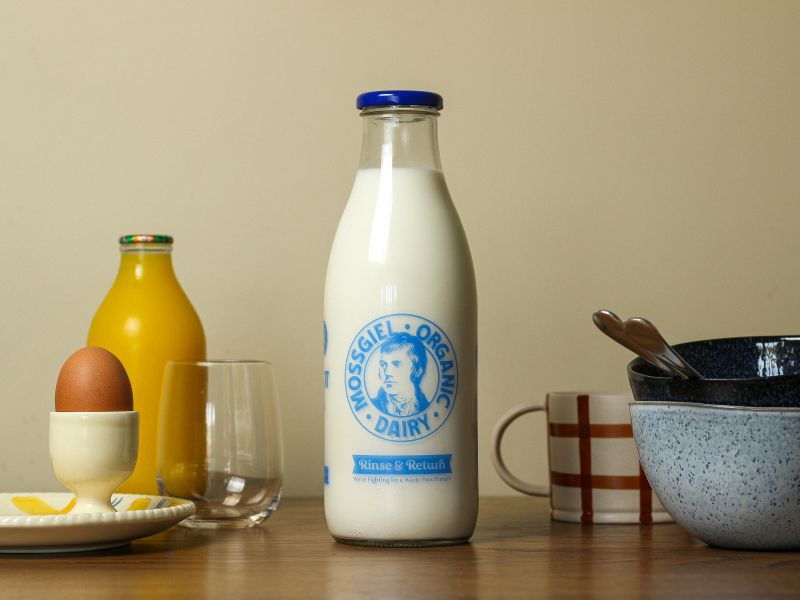
That may hint at where the brand goes next. Today the model is direct-to-consumer, but asked whether partnerships with premium coffee brands or coffee shops could follow, Thomason smiles: “Watch this space.”
The operational case is strong. One-litre bottles appeal to households with tighter fridge space. The return-and-reuse system cuts plastic. Customers like seeing “far less plastic in their bins”, she says, and often mention concerns around microplastics.
And shelf life is practical rather than niche: five days minimum on delivery, three days once opened, in line with much of the wider fresh category.
Can dairy clean up its footprint?
The next challenge is bigger than packaging. “Milk is a high-carbon industry,” Thomason says plainly.
Like the rest of dairy, Modern Milkman is watching sector-wide sustainability advances such as feed innovation, methane reduction and regenerative farming. But Thomason explains that there is tension between lowering emissions and maintaining consumer trust.
“How do we make dairy more sustainable while making sure customers still feel they’re getting a high-quality, uncompromised product?”

That balancing act may define the category over the next months and year, but for now, however, the company is focused on breakfast. Thomason says economic pressure is nudging more consumers towards eating at home rather than out, creating a room for indulgence in smaller ways: better eggs, better coffee, better milk.
Modern Milkman started by reviving the milk round, but Thomason says its next phase may be turning breakfast into affordable luxury. Looking ahead, she says Modern Milkman expects to deepen its own-label range, expand premium partnerships and push further into breakfast-at-home occasions, where convenience and quality increasingly overlap.
However, over the longer term, its challenge will be scaling a circular delivery model while proving to both itself and consumers that sustainable, higher-margin grocery can move beyond niche and into the mainstream.
Click here to sign up to Retail Gazette‘s free daily email newsletter